Rehumanising Accounting Through Ubuntu: What AI Cannot Teach
by Dr Chipo Simbi, University of Southampton
Throughout my teaching, I have been fortunate to receive unsolicited letters and emails from students at the end of each module. While many thank me for helping them understand challenging accounting concepts, what stays with me are the comments about feeling seen and valued. One student's words have remained with me: "You spoke to me with care, understanding and real motivation. You told me not to be afraid of expressing myself in English". That email reminded me that students often remember far more than the technical content; they remember the moments when someone believed in them enough to help them find their voice.
Reflecting on this experience made me question what students value most from their accounting education. While our teaching is rightly grounded in technical frameworks such as IFRS, technical competence alone does not define an accountant, but a learning environment that builds confidence and a sense of belonging is equally important. Small acts of care, such as learning students' names, encouraging participation, embracing diverse perspectives, and creating an inclusive classroom, can profoundly shape students' confidence and sense of belonging. These practices also enhance student engagement by helping learners feel recognised, valued, and connected within the classroom community ( Enhancing student engagement).
Only later did I recognise that these practices reflected the philosophy of Ubuntu: "I am because we are" ( Mogobe Ramose, 2024). In creating a psychologically safe classroom where students could question, contribute, and embrace uncertainty (Edmondson, 1999), I was nurturing more than just belonging:I was developing the confidence that underpins professional judgement, ethical reasoning and critical thinking, competencies recognised by the International Education Standards alongside technical expertise (IFAC). These human capabilities are cultivated through relationships and trust, reflecting the Ubuntu philosophy that individual growth is achieved through community and mutual support.
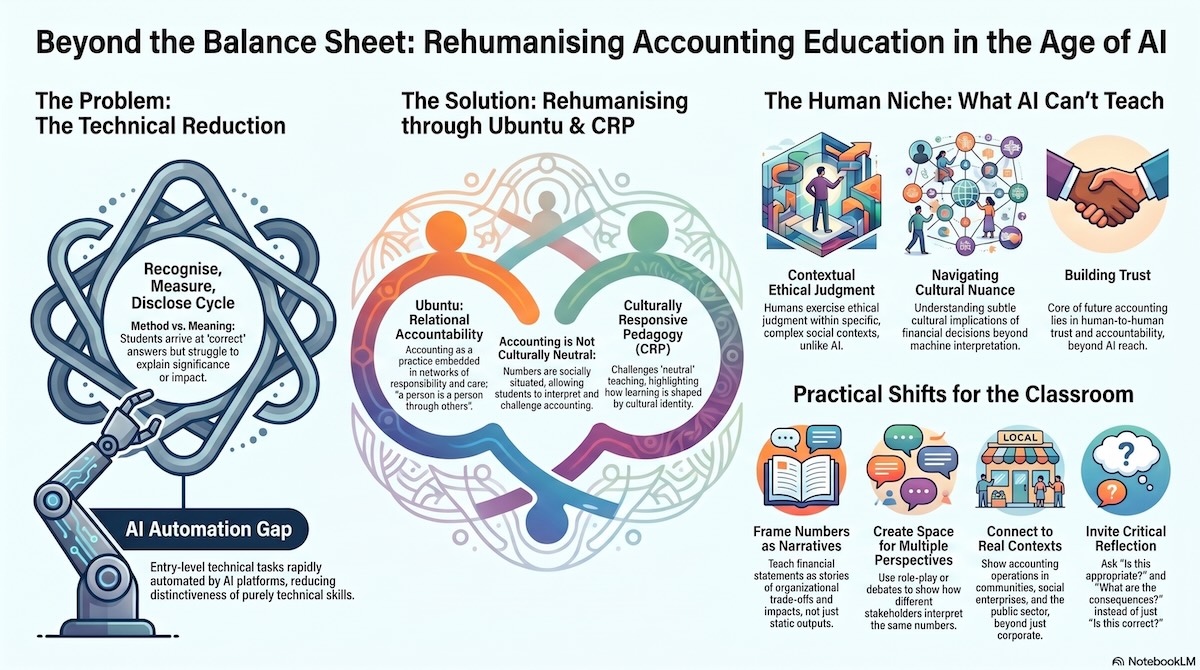
Reflecting on how these classroom practices fostered students’ confidence, sense of belonging, and professional development has made me think differently about the role of accounting educators at a time when AI is changing both higher education and the profession itself. AI is already very good at processing data, applying accounting standards and generating technically accurate outputs. But it cannot notice the student who has lost confidence, encourage someone to contribute for the first time, or create the trust that gives students the confidence to question, debate and learn from one another. Those moments are where much of the learning happens. Rehumanising accounting education through Ubuntu encourages us to create learning environments where technical competence is developed alongside the judgement, empathy and sense of responsibility that define the very best qualities of an accounting professional.
Why rehumanise accounting
Rehumanising accounting education widens the lens, recognising that accounting did not emerge as a neutral system of calculation but as a socially embedded practice shaped by human interaction, institutional contexts, and relationships of accountability (Carnegie and Napier, 2012). It was a way of making relationships visible, of recording obligations, managing shared resources, and enabling accountability. Rehumanising accounting education, then, means reconnecting with the relational, ethical and community-oriented dimensions of accounting that have often received less attention than technical competence.
One way of rethinking accounting education is to draw on perspectives that foreground relationships, context, and human experience. The philosophy of Ubuntu, often expressed as “ a person is a person through others”, is a pedagogical philosophy that reminds us that knowledge and practice are inherently relational. It invites us to see accounting not simply as a system of measurement, but as a practice embedded in networks of responsibility, care, and mutual accountability.
Viewing accounting through this wider lens invites students to consider:
- Who is impacted by this representation of financial performance?
- What responsibilities do organisations have to those beyond shareholders?
- How do accounting choices reflect, or obscure, relationships of power and accountability?
These are not questions with neat numerical answers. But they are central to understanding what accounting is. They reinforce interconnectedness, relational accountability, collective well-being, and stewardship simultaneously.
In one class on IAS 36Impairment of Assets, I asked students to evaluate a company whose management used optimistic cash flow projections to avoid recognising an impairment loss. Rather than focusing solely on the technical calculation, we discussed who would be affected if the assets were overstated: investors, lenders, employees and the local community that depended on the business. Students debated whether professional responsibility should extend beyond compliance to transparency, stewardship and accountability. The discussion demonstrated that accounting decisions are never made in isolation; they affect people, relationships and communities, requiring ethical judgement, stakeholder awareness, contextual reasoning and cultural sensitivity alongside technical expertise.
How, then, can we teach differently?
If Ubuntu reminds us why relationships matter in accounting education, then culturally responsive pedagogy (CRP) offers practical ways to bring this philosophy into our classrooms. Developed by Gloria Ladson-Billings, CRP encourages educators to recognise students' cultural identities, languages and lived experiences as assets for learning. This does not require rewriting the curriculum or abandoning IFRS; it requires asking different questions. Using familiar standards such as IAS 36, we can move beyond technical calculations and invite students to consider who is affected by accounting decisions, whose voices are represented, and whose remain invisible. Bringing Ubuntu and CRP together shifts accounting education from simply teaching standards to helping students understand who those standards serve. In doing so, we nurture ethical judgement, contextual reasoning, stakeholder awareness and cultural sensitivity, qualities that will define thoughtful, trusted and socially responsible accountants. In practice, this may involve framing numbers as narratives, exploring multiple stakeholder perspectives, connecting accounting to real-world contexts, encouraging ethical reflection, and using creative approaches that engage students beyond procedural thinking.