From Mystery to Mastery: A Framework to Unlock Critical Thinking Skills
by Suzanne McCallum, University of Glasgow, Scotland
Why critical thinking matters
In a world of constant change, shaped by Generative AI and other emerging challenges, I ask myself how I can help my students in their future careers? My answer: help students develop critical thinking skills so they can use their own judgement and critique and question information from any source (AI or other humans).
But what is critical thinking?
While I have an intuitive understanding of this concept, I must admit I struggle to articulate it in a meaningful way that would resonate with my students. Looking to academic literature to help, there is no single definition, but generally critical thinking is considered as a range of cognitive skills and dispositions. With all this complexity in something as simple as a definition, how could I help my students build their critical thinking skills?
What do my students think?
After much thought I decided that rather than imposing an abstract academic definition, I wanted a definition that students could use. The best pedagogic approach was therefore to canvas student views so we could co-create a definition of critical thinking and its components. Taking this step allowed me to assess my students’ starting point; while involving them in the discussion and construction of some kind of common framework meant it was stated in language that was meaningful to them.
I was so impressed with the thoughtfulness and clarity of my students’ response. They produced some amazing answers, and I then combined these into a critical thinking framework that we could use within the class. This identified a range of important processes; these are summarised in Figure 1 with a fuller explanation given below.
Figure 1: The process of critical thinking, as defined by students
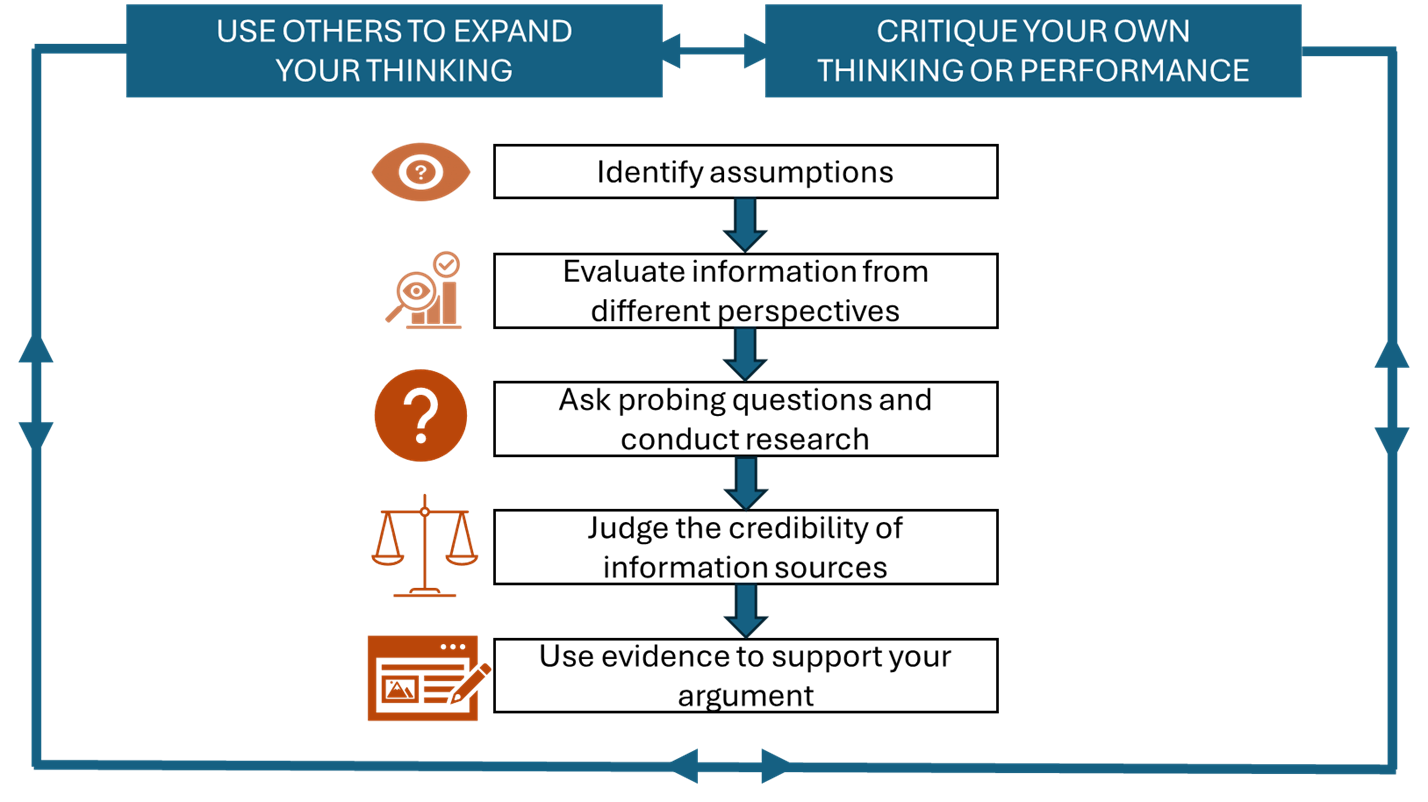
My students’ critical thinking framework (Figure 1) – the basics:
Identify assumptions:
Some may be less obvious than others and may even be hidden. Assumptions can come from prior experience and biases (including unconscious bias) so actively considering assumptions is important. If they remain hidden, they can limit the ability to be ethical and open minded.
Evaluate information from different perspectives:
Looking at a situation through different lenses allows a wider perspective to be considered e.g. comparing the views of accounts users versus accounts preparers. Don’t just accept the most familiar interpretation of information without considering alternative views. Take time to pause and think about other relevant perspectives.
Ask probing questions and conduct research:
Once assumptions have been surfaced and different perspectives identified, research can be carried out in a mindful way (helping to reduce bias). Information from different perspectives can be researched and reviewed, helping you engage in reasonable reflective thinking before deciding what to do or believe.
Judge the credibility of information sources:
In an era of information overload and fake news, consider the quality and reliability of the evidence source. Consider questions like:
- Is the information from an unregulated website, IFRS or an academic journal article?
- How much scrutiny did it pass through before being published?
- How much evidence supports the statements made?
- Is the author likely to be biased?
This links back to the prior steps, as you need to think about any assumptions (and potential bias) within sources, ensure you are considering different perspectives and ask probing questions about the information you are reviewing.
Use evidence to support your argument:
If all the prior steps have been successfully negotiated, then draw together the information gathered and give appropriate justification for the view or course of action selected. (Arguments and counterarguments should be addressed.)
My students’ critical thinking framework (Figure 1) – the essential recursive steps:
This framework is not purely linear. It has a further two recursive dimensions (shown at the top of Figure 1). These elements increase the power of the framework and must be integrated at all steps.
The first of these (use others to expand your thinking) recognises that we all have inherent bias and this may limit our thinking. Using peers as a “critical mirror” helps identify and reflect these biases and underlying assumptions, so we can be aware of them and try to counterbalance them.
The other important and recursive step is to critique your own thinking or performance. Actively building in opportunities for self-reflection has metacognitive benefits and helps improve the critical thinking process.
How did I use it and what next…
After witnessing what the students developed, I immediately realised how valuable it would be to scaffold this into my class. We discussed the framework every week, with students matching tasks against the framework to see when they were (or should be) activating and honing their critical thinking skills. I even built this into the assessment task: asking students to write about how they used the framework when preparing an assessed group report. All of this put critical thinking right at the heart of my course and instead of being a background process (that I hoped was happening) it was demystified and made visible.
Given how well this worked, I fully intend to use this framework regularly in all my classes (including first year), as the sooner I raise students’ awareness of what critical thinking is and how they can develop their skills, the better: especially in quantitative parts of the course where they need to think about more than technical knowledge.
But what does this mean for you?
If we want to build a generation of accounting graduates who look beyond the numbers and are equipped to deal with varied problems (and I think we do) then you should use this framework with your students too. It’s not a recipe or tick box approach, but a starting point for discussion to actively engage your students in critical thinking using my students’ framework. It transfers to any discipline, so no matter what you are teaching you should start using it now.