Collaborative student learning through authoring, answering and peer reviewing Multiple-Choice Questions (MCQs)
by Gavin D’Northwood, Durham University, UK
Introduction
In this blog I present an activity that I have used to encourage deeper learning in students through their engagement in authoring, sharing, answering, and peer reviewing multiple-choice questions (MCQs) (hereafter referred to as ‘the activity’). I believe that if students engage constructively then the activity can and from my experience does help with knowledge acquisition and skills development. I provide here an exemplar of the activity within a second-year undergraduate elective module, Business Law, delivered primarily to accounting and finance students, covering the process as enacted and suggesting some of the potential benefits for students.

I have authored countless MCQs over the years in subjects such as business law, business finance, financial accounting and reporting, and management accounting. This to me is a good way of ‘getting to know your stuff’. I have used MCQs to test students at different levels, adjusting for progressive difficulty. Students can attempt to emulate that. The more complex, the more difficult they try to make an MCQ, the more they must dig into their knowledge and/or augment that through research. It can take some effort to make a question work, to maintain the logic, to get the answer correct, without giving that away in the question, whilst providing plausible distractors, to make it suitably challenging. The process of achieving that helps students to work through their liminal space to reach their own understandings and consolidate their knowledge.
From where did the idea originate?
I can’t claim originality here. In truth, I was alerted to the activity by a Scientist colleague who was using it to good effect with her first-year undergraduate Chemistry students. I think it lends itself to scientific disciplines as knowledge intensive, so its use is not surprising, but I have not seen it employed in business disciplines. I saw the potential for accounting subjects in which we often assess students via MCQs, at least at L1 UG and in foundation levels of the professional exams. I have borrowed it then, but also made it something of my own in implementation.
A collaborative learning tool
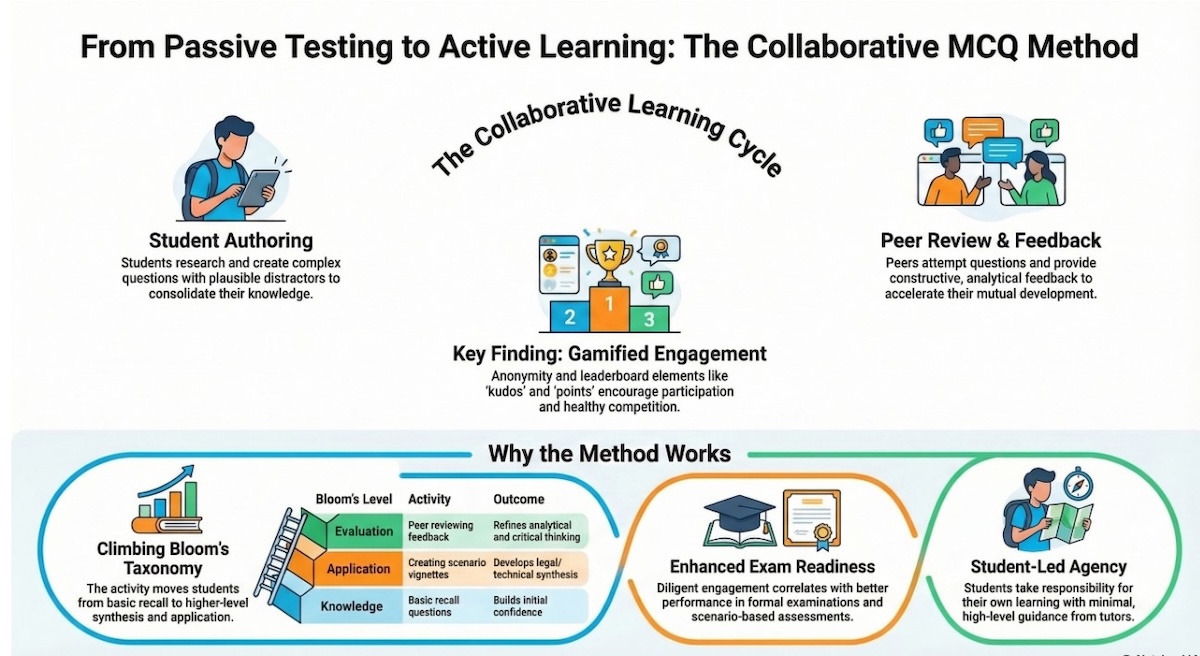
The activity is foremost a collaborative learning tool which I integrated into a module to augment the traditional lecture/seminar mode of delivery. My part is in initial set-up, priming, and in ongoing facilitation. I set up the database that hosts the activity, I explain the requirements early in the module – previously via a live lecture but more recently through a pre-recorded instructional video – selling the benefits of engagement for building knowledge and skills and as an aid to revision, and I task students at intervals with authoring MCQs which they post to the database for their peers to attempt, rate, review and provide feedback on. Ideally, all students will participate in authoring and reviewing questions throughout the module.
In the introductory lecture/video I talk briefly and in simple terms through Bloom's Taxonomy, contextualised to the module. I suggest that in authoring questions students might start with some basic knowledge at the lower tier – e.g. ask a question such as ‘How many law Lords sit in a typical hearing at the Supreme Court?’ – which simply begs for some basic knowledge, it does not require application, it is just something students will or will not know. This can build a bit of confidence in the process. From there, students can work on developing their comprehension such that they are progressively able to synthesise and apply knowledge. They could, for example, develop small vignettes, flesh out scenarios to varying degrees, give their peers something to think about with options purportedly covering the likely legal implication(s). In responding, peers would have to think carefully through the giving information and apply their knowledge of the law to work out which of the options is correct and why the remainder should be dismissed. And so now we're driving their engagement and learning.
I try not to make the volume of work too onerous so that students focus more on acquiring depth of understanding. Subject to cohort numbers, which fluctuate yearly for Business Law as an elective module, I generally task each student with authoring up to 10 MCQs drawing on subjects and material from across the module. This can generate a sizeable database, subject to engagement levels, which similarly can vary from cohort to cohort, my efforts at promoting and cajoling notwithstanding. I also ask students to choose a similar number of questions to attempt from their peers, attempt meaning answer, review, rate and provide detailed feedback. It is in those aspects beyond simply answering, in the consideration given to review and the depth of feedback, where students can accelerate their development. I of course stress the need for students to be respectful of each other in giving responses. Be analytical, be constructive, but also tactful and civil.
Gamification
I organise the activity through PeerWise, which is ready made and free to use. I imagine other sources are available, or the activity could be managed without same, I find that it just makes things easier. A points scoring system is provided. Scores are a composite of questions attempted correctly and feedback given and received. Students can be awarded kudos, like runners on STRAVA, they can tag and follow authors, like their favourite YouTubers, and there is a league table. Students can take some pride from seeing where they are placed but no one need know, students’ anonymity is protected by the adoption of usernames. Some students like this added element of competition, some don’t. I say to them you don’t have to worry about the league table, you don’t have to look at it if you don’t want to, just focus on what you are trying to do and what you get out of the activity.
What are the benefits?
Students benefit from authoring questions and from giving and receiving peer feedback. This can help develop a deeper understanding of the subject. Additionally, students take an active part in and so some responsibility for their own learning. I go in from time to time and add points of guidance and clarification, but it’s far more peer than tutor review. I do not necessarily police the system, although I do check that respect is being observed. I also check for and, if necessary, chase engagement. And I’m there to bounce ideas off. Other than that, I am fairly hands off. This is an activity for the students.
Business Law is examined by an invigilated exam split into Sections A (MCQs + explanations) and B (scenario/essay questions). Anecdotally, I have found that students who engage diligently with the activity have tended to perform well in the exam. Of course, they may simply be good students who would have performed anyway, but students have said that the activity has helped them to prepare for the exam, directly in the case of Section A. The activity asks students to give and receive feedback, to unpick a question, apply legal knowledge, and explain how, where, and why a question goes right or wrong; all of that is valuable exam preparation work.
Formative assessment
I have covered here the incorporation of the activity into a module to facilitate collaborative learning. Where I hoped to depart from the norm and add some additional value was to attempt to also use the activity for formative assessment, i.e. to help diagnose issues and to take corrective action ahead of the exam. In purist terms this is more invasive and time consuming. It would involve me interrogating each student’s database profile of activity to build a picture of strengths, weaknesses, knowledge, and understandings, to create bespoke formative feedback. This has not been possible due to time constraints and varying levels of student engagement. I have found myself instead reviewing across students’ profiles to pull out points of more generic advice. However, I hope to develop this aspect because if I can make it workable then I believe it could really benefit the students.